
Google Business Profile for Lawyers: A Chicago Attorney’s Local Visibility Checklist
A policy-aware checklist for Chicago law firms reviewing Google Business Profile accuracy, local visibility signals and the website path a prospective client sees next.
The practical brief
Read it as an operating guide.
Clear decisions, verified boundaries and a useful next step—without a ranking promise.
Treat the profile as a client-facing fact sheet—not a ranking lever
A Google Business Profile is often the first compact version of a law firm a prospective client sees: firm name, category, address, hours, phone number, reviews and the link that follows the searcher back to the site. That makes the profile an accuracy and trust surface before it is an SEO task. For a Chicago firm, the useful question is not “How do we own every neighborhood?” It is “Does this profile make it easy for the right person to understand our real office, services and next step?”
Google’s own guidance starts with real-world representation. Its Business Profile rules ask businesses to present themselves consistently across signage, stationery and branding; keep addresses or service areas precise; choose only the categories needed to describe the core business; and avoid duplicate profiles. Those are practical operating controls for a firm—not shortcuts to a promised map position.
Start with the parts that must match the real firm
Before discussing posts, photos or review volume, compare the profile against information the firm can actually verify. Use the firm’s public-facing name as it appears in the real world. Confirm the office address or service area, primary phone number, website destination, normal hours and special hours. Then ask the people who run intake whether a caller who follows those details reaches the right team during the hours the profile promises.
This is also the point to make a deliberate category decision. Google advises businesses to use the fewest categories needed to describe their overall core business. A category should describe what the firm genuinely offers, not every search phrase the marketing team hopes to capture. When facts change—an office moves, intake hours shift or a location closes—treat the profile as an operational update, not a quarterly marketing clean-up.
- Firm name and public brand match the firm’s real-world presentation.
- Address, service area, hours and phone number are confirmed by an operations owner.
- The website link lands on a relevant, working page—not a generic or broken destination.
- Categories describe the firm’s actual core services without unnecessary duplication.
Decide how the firm and its lawyers are represented before adding profiles
Law firms frequently have a mix of a firm-level presence, lawyers who are publicly associated with the firm and multiple office locations. The right profile structure depends on the firm’s real operations and Google’s current practitioner guidance. Do not create individual lawyer profiles simply to add more map entries, and do not merge distinct real-world identities into a structure that confuses a client who needs to contact the firm.
Instead, document the facts first: which locations accept in-person clients, which lawyers are client-facing under their own professional identity, who owns profile access and what happens when an attorney joins or leaves. Then have the person responsible for firm marketing or professional-responsibility review confirm that the public presentation is accurate. This article is marketing and website guidance, not an interpretation of legal advertising rules or Google’s policy for a particular firm.
Make the click from Google useful to a prospective client
A complete profile still hands the visitor to a website. If that next page is vague, slow or unrelated to the service they searched for, the profile has only moved the friction downstream. The linked page should state what the firm helps with, make its Chicago office or service footprint clear where that information is true, explain a sensible next step and present an obvious way to call or contact the firm.
Check this path on a phone. Use the phone number shown in the profile, tap the website link, inspect the page at a normal mobile width and see whether the intake path is clear without asking a visitor to disclose sensitive information in a general form. Count the click, call or form start as an observable action—not proof of a qualified lead, a consultation or a retained matter.
Build a review response workflow that protects confidentiality
Review replies can show that a firm pays attention, but they are not the place to discuss a person’s legal matter, confirm representation or invite confidential details into a public thread. Assign ownership for review monitoring, create an escalation path for difficult feedback and give the response owner clear boundaries about what can be said publicly. The goal is a consistent client-service process, not a stock response pasted under every review.
Google notes that positive reviews and helpful replies can help a business stand out, while its profile policies prohibit content that includes private or confidential information. That is enough reason to connect the review process with a firm’s own communication, privacy and professional-review practices before publishing anything. If a review raises a substantive concern, route it to the appropriate firm owner rather than trying to solve it in a public marketing reply.
Keep the local-visibility conversation honest
Google says local results are mainly based on relevance, distance and prominence. Complete, detailed business information can help Google understand a profile’s relevance; distance is tied to the searcher’s location; and prominence reflects how well-known a business is, including signals such as links and reviews. Those factors explain why two people in different parts of Chicago may not see the same local results for a similar search.
The operational takeaway is simple: improve the facts and pathways a firm controls, then observe visibility without turning a screenshot into a promise. Google also states there is no way to request or pay for a better local ranking. Avoid agencies, tools or internal reports that treat a category change, a review request or a single ranking scan as a guaranteed outcome.
- Track whether the profile is complete, accurate and verified.
- Review whether the linked page answers the intent behind the profile visit.
- Monitor search visibility as a signal, with location and query context documented.
- Separate calls, form activity and firm-side intake outcomes in reporting.
Use website schema as a consistency check—not a profile substitute
Structured data on a firm website can help search engines interpret the business information presented on the page, but it does not replace an accurate Google Business Profile. Google’s LocalBusiness documentation emphasizes adding accurate properties to pages that contain real business information, validating the markup and keeping the page accessible to Google. A schema block should reflect visible, approved facts—not create a second version of the firm’s story.
For a law firm, that makes schema part of the same governance routine: compare public site facts, the Google profile and approved operations information. If the firm cannot verify an address, department, office hours or service claim, it should not be added to the website markup merely because a field exists. One reliable source of truth is more useful than a stack of conflicting local signals.
Run the checklist in an order that prevents rework
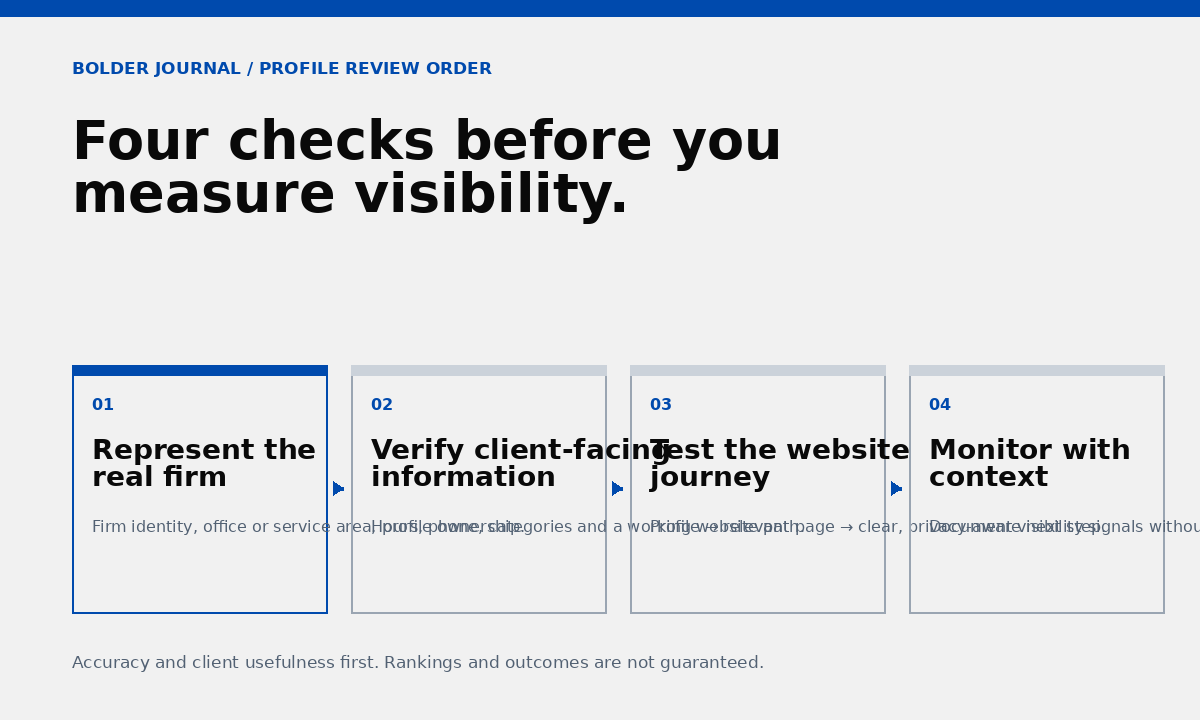
The fastest way to create avoidable cleanup is to start with cosmetic edits before anyone agrees on the firm’s actual public facts. Run the review in a fixed order: representation first, client information second, linked-page and intake journey third, then monitoring. That sequence lets the firm correct the high-risk inconsistencies before spending time on lower-priority profile activity.
For a Chicago firm with multiple stakeholders, keep a dated record of who verified each fact and who owns the next update. This does not turn the profile into a compliance program. It simply gives marketing, operations and the attorneys responsible for public communications a practical handoff when details change.
- Confirm the real firm identity, office or service area and profile ownership.
- Validate client-facing details, categories, hours, phone and website destination.
- Test the mobile path from profile to site to call or contact action.
- Set a review-response boundary and escalation owner before responding publicly.
- Document the monitoring view and the limits of what it can prove.
Continue planning
Related Bolder guides
- SEO for LawyersSee the wider technical, content and local-search foundations for Chicago law firms.
- Law Firm Website DesignReview the website journey that starts when a profile visitor clicks through.
- GEO for Law FirmsExplore the adjacent work of making firm information clear for AI-assisted discovery.
Make it practical
Turn the idea into a visibility system.
Talk through the website, search and AI-discovery work that is most useful for the professional practice you want to grow.